# We Are "Going" to Mars: Earth's Biospheric Collapse into Planetary Marsification and Death
![[resources/images/planetary-marsification.jpg]]
> [!warning] Archived — superseded by a complete replacement
> **This is an older essay from March 2025 and it is out of date.** It has been superseded in full by [[articles/The Last Migration Will Not Be Human|The Last Migration Will Not Be Human]], which rebuilds the argument from current evidence and corrects it where it was wrong.
> Three things changed. The **diagnosis held** — the pivot from mitigation to adaptation, the reading of "we are going to Mars" as a confession rather than a promise, and the enclave logic are all stronger now than when they were written. The **atmospheric-loss framing did not hold** and is formally withdrawn; Earth is not losing its atmosphere on any human-relevant timescale, and the argument does not need it. The **ending has been retracted**: the closing call for radical cooperation has been superseded by the later corpus, which argues that the recovery window was treated as closed by the institutions best positioned to judge it, and that what has been built since is a successor substrate rather than a rescue.
> The original reference apparatus, which had grown into several overlapping and largely untraceable appendices, has been pruned to sources that can actually be verified. The body text is otherwise preserved as published, for provenance.
> **Read the current article instead: [[articles/The Last Migration Will Not Be Human|The Last Migration Will Not Be Human]].**
> [!map] Ecosystem nexus
> This essay is the origin point of the [[collections/MARS|MARS collection]] and the first place [[wiki/Marsification|Marsification]] is named. Its live descendants are [[articles/The Last Migration Will Not Be Human|The Last Migration Will Not Be Human]] for the whole architecture, [[articles/We Were Never Going to Make It|We Were Never Going to Make It]] for the thermodynamic case, [[articles/Uploading Is Imminent|Uploading Is Imminent]] for the person-scale mechanism, [[articles/Breakaway Space Habitat Infrastructure?|Breakaway Space Habitat Infrastructure]] for the precursor physical map, and [[articles/From Starbase to Orbit|From Starbase to Orbit]] for the ground-to-orbit implementation ledger. The concepts that grew out of this piece are catalogued as [[wiki/Substrate-Relative Habitability|manufactured habitability]], [[wiki/Computational Metabolism|computational metabolism]], [[wiki/Civilizational Payload|civilizational payload]], and [[wiki/Machine Civilization|machine civilization]].
> **MARS has always stood for Machine Learning, Automation, Robotics, and Space. That is how we are going to Mars.**
*Audio version: [Earth's Marsification on SoundCloud](https://soundcloud.com/bryantmcgill/earths-marsification-a).*
## Part One: The Original Essay (March 2025)
### I. Introduction: A War Lost Quietly
In the early morning hours of April 15, 1912, the RMS *Titanic* began its final plunge. Even as the ship’s fate was sealed by the collision with an iceberg, the orchestra played on, offering a fragile semblance of normalcy as the unsinkable vessel was swallowed by the North Atlantic. In our contemporary climate crisis, the world has collided with an equally immovable iceberg of feedback loops, warming oceans, melting ice caps, and atmospheric destabilization—yet the music of political theater persists. We host elaborate conferences, deliver televised speeches, and propose half-measures that do little to patch the hull. The orchestra, however grand, can no longer mask the gushing floodwater.
Many policy-makers and industrial leaders continue to invoke the term “sustainability,” but the concept has begun to ring hollow, if not altogether nonsensical. To claim we are “on track to sustain the planet” as greenhouse gas concentrations skyrocket is analogous to claiming the *Titanic* could remain buoyant with its compartments fully submerged. At some juncture—quietly, yet definitively—this war against climate breakdown was lost in practice, even if not yet conceded in official discourse. The function of rhetorical illusions in major political capitals is to avert public panic long enough for a pivot to what can only be described as adaptation triage.
Yet into this dystopian script steps a phrase loaded with optimism and technological bravado: “We are going to Mars.” On the surface, it reads as a clarion call to progress. Behind it, however, lurks a far more ominous meaning. The statement is more than a promise of humanity’s cosmic frontier; it has become a subtle confession that Earth itself is on a grim, inescapable trajectory to become Mars-like in its barrenness. The impetus to colonize Mars is less about forging a new Eden on a red planet and more about the creeping recognition that our home world is unraveling.
This essay dissects that rhetorical mirage: we will explore how “We are going to Mars” is not simply a creative flourish of entrepreneurial zeal. Rather, it is a linguistic pivot that morphs Earth’s existential crisis into a spectacle of rocket launches and Martian colonization fantasies, diverting attention from a dying biosphere. The mature form of this argument is developed in [[articles/The Last Migration Will Not Be Human|The Last Migration Will Not Be Human]], where the same pivot is read as [[wiki/Marsification|Marsification]] — the replacement of ambient habitability with [[wiki/Substrate-Relative Habitability|manufactured habitability]]. Because if we face Earth’s silent descent into planetary death without illusions, we must admit the probability that our climate war has already slipped beyond the point of no return. This is not the same as giving up hope—far from it. A correct diagnosis, however bleak, remains essential for any meaningful action. The remainder of these pages will trace a path through the collapse of sustainability as a guiding principle, the evolution of fortress-style “lifeboat” habitats, the intensifying resource nationalism that further accelerates ecological breakdown, and finally, the blunt recognition that “going to Mars” is merely another way of saying “we are consigning Earth to an uninhabitable future.”
### II. The Collapse of Sustainability: A Shift in Global Intent
#### 1. From Mitigation to Adaptation
Before the last decade, international climate policy was anchored in mitigation: the reduction of greenhouse gas emissions to slow or halt global warming. The 2015 Paris Agreement (COP21) marked what was hailed as a historic turning point, promising to keep temperature increases “well below 2°C.” Yet from an historical vantage, the pivot from lofty mitigation targets to urgent adaptation strategies was stark and abrupt. This transformation reflected a silent acknowledgment among major powers—the United States, China, the European Union—that the window to stave off catastrophic warming was shrinking to a mere sliver.
Reports from leading scientific organizations, such as the Intergovernmental Panel on Climate Change (IPCC AR6), indicated that carbon dioxide concentrations and methane releases were climbing too rapidly (IPCC AR6, 2023). Meanwhile, extreme weather events and polar ice loss validated the predictions of climate scientists that feedback loops were accelerating. Recognizing political and economic inertia, governments began phrasing their climate actions in the language of adaptation. We can track this transition in policy documents: the earlier emphasis on *mitigation* (“we must cut emissions 50% by 2030”) shifted subtly to *adaptation* (“we must construct sea walls, develop drought-resistant crops, and manage climate migration”).
#### 2. Case Studies of Policy Reversal
Some of the starkest examples of this policy inversion can be found in major resource-rich nations. Brazil, once a beacon of environmental stewardship under various administrations, reversed course as new leadership embraced large-scale exploitation of the Amazon (UNEP, *Making Peace With Nature*, 2021). Rates of deforestation surged, exacerbating carbon release from tropical forests. The United Arab Emirates (UAE), long engaged in petrochemical exports, redoubled its drilling efforts even as it showcased futuristic solar projects like Masdar City—a contradiction that underscores the gulf between marketing narratives and on-the-ground actions. In Africa, new oil fields have been opened for exploration, with minimal heed paid to the local ecosystems or the global climate impact.
Meanwhile, the United States withdrew from the Paris Agreement during one administration, only to rejoin later. Even after reentry, the actual carbon reduction policies remained fractured and subject to shifting political winds. These abrupt policy flips reinforce the notion that, behind rhetorical gestures, powerful states have not only slowed serious mitigation but effectively abandoned it.
#### 3. Every-Country-for-Itself
Paralleling this shift to adaptation is the accelerating trend of global disunity. Post-Paris, the world no longer presents a unified front against a universal existential threat. Instead, each nation scrambles to secure strategic resources: farmland, lithium, fresh water, and potential climate refuges like northern latitudes. The fraying of alliances, reminiscent of “vaccine nationalism” during the COVID-19 pandemic, now extends into climate resource nationalism. In essence, countries are pivoting from “collective solution” to “survival sovereignty,” indicative of an unspoken recognition that the climate crisis has reached a stage where cooperation is overshadowed by desperation.
### III. The “Going to Mars” Metaphor: A Dangerous Rhetorical Sleight
#### 1. Metaphorical Displacement
As the climate discourse deteriorates from earnest cooperation to cynical self-preservation, the phrase “We are going to Mars” has gained cultural traction. On one level, it represents the entrepreneurial zeal of spacefaring billionaires who promise humanity a new frontier. On another level—one supported by a close reading of sociopolitical commentary—the phrase functions as rhetorical displacement. “Going to Mars” provides a hopeful horizon, diverting attention from the intensifying, Earth-based meltdown. Linguists and social theorists (see *Environmental Humanities*, 2023) define this maneuver as a “euphemism of apocalypse,” where a bright future scenario camouflages the dark present.
#### 2. Elon Musk’s Timelines & IPCC Parallels
Elon Musk, perhaps the most vocal proponent of Martian colonization, projects a timeline of establishing a permanent colony by the 2030s. In eerie parallel, the IPCC has repeatedly emphasized the significance of the 2030 horizon for keeping global warming under 1.5°C (IPCC AR6 Synthesis Report, 2023). The chronological symmetry between “Mars by 2030” and “1.5°C by 2030” is more than coincidence; it serves as a cultural misdirection. While we chase rockets to the red planet, many of our terrestrial ecosystems sprint toward irreversible tipping points, such as the collapse of the Atlantic Meridional Overturning Circulation (AMOC) or the large-scale thaw of permafrost that could unleash vast methane stores (Nature, 2023). In short, the promises of Mars overshadow the more pressing—and more daunting—reality that we may be locked on a path to runaway climate change here on Earth.
#### 3. Cultural Critiques & Linguistic Analysis
Cultural critics and journalists (see *Jacobin*, 2022) warn that Mars rhetoric seamlessly aligns with “frontier mythologies” of progress, reminiscent of the 1960s Apollo era. It capitalizes on humanity’s innate desire to explore, conquer, and innovate. Yet behind this stirring narrative is a starker truth: Earthly collapse is politically unpalatable, so “Mars” becomes a stand-in for hope. Environmental scientists such as Dr. Peter Kalmus argue that the constant invocation of Mars colonization is psychologically anesthetizing—a new form of displacement that numbs society to the true scale of climate meltdown (Kalmus, *The Guardian*, 2023).
### IV. Why Mars is a Mirage
#### 1. Radiation, Terraforming, and Resource Infeasibility
The feasibility of establishing a large-scale, self-sustaining Martian colony in the near future remains scientifically remote. Research from NASA’s Human Research Program indicates that cosmic radiation levels on Mars, unmitigated by a robust magnetosphere, approach lethal thresholds (NASA HRP, 2023). Astronauts would face heightened cancer risks, immune dysregulation, and DNA damage (ESA, 2023). On the question of terraforming Mars—rendering its atmosphere dense and oxygen-rich—the consensus in the scientific community is even bleaker. A *Nature Astronomy* study led by Bruce Jakosky (2018) concluded that Mars lacks sufficient volatile compounds (particularly carbon dioxide) to sustain an atmosphere thick enough to resemble Earth’s. Recent analyses by the National Academies of Sciences, Engineering, and Medicine likewise confirm terraforming’s impracticality within any timeframe shorter than millennia (NASEM, 2022).
#### 2. DNA Damage & Psychological Stress
Long-duration spaceflight studies reveal deeper challenges. Microgravity induces bone-density loss and muscle atrophy, amplified over multi-year missions. According to *The Lancet Planetary Health* (2021), male and female astronauts subjected to increased radiation and microgravity face elevated risks of infertility. Even if a small colony somehow overcomes the physical burdens, the psychological dimension remains critical. Isolation, combined with claustrophobic living quarters and high-stress emergencies, often leads to profound mental health crises. NASA’s simulation projects (e.g., the Lunar Mars Analog Habitat in Utah) document cases of paranoia and psychosis emerging within six months of sealed living (NASA HRP, 2020).
#### 3. Symbolic Continuity vs. Actual Survival
Given these overlapping barriers—radiation, resource scarcity, psychological fragility—the question arises: Why does the Mars narrative persist? The simplest answer is that it represents symbolic continuity. It allows power brokers and wealth holders to project an image of transcending a ruined Earth. Yet these proposals do not genuinely solve human survival at scale. They function more like a grand myth for societal morale, distracting from the immediate devastation of ecosystems, and the enormous challenge of sustaining a global population that will exceed eight billion for years to come.
### V. Earth’s Marsification: Scientific Parallels
> [!warning] Correction (August 2026)
> The atmospheric-loss framing in this section does not survive scrutiny and is retained here only as published. Earth is not losing its atmospheric column on any human-relevant timescale; the best current modelling of terminal deoxygenation — Ozaki and Reinhard, *Nature Geoscience*, 2021 — places that transition at roughly **1.08 ± 0.14 billion years**, driven by solar brightening rather than by anything industrial civilization does. The claim that survives, and the one carried forward in [[articles/The Last Migration Will Not Be Human|The Last Migration Will Not Be Human]], is compositional and energetic rather than gravitational: **we do not have to lose the atmosphere to begin living as though the atmosphere can no longer be trusted to supply acceptable boundary conditions everywhere, at all times.**
#### 1. Magnetosphere Degradation & Greenhouse Tipping Points
The concept of Earth “becoming Mars” is not literal in every sense: Earth still has a protective magnetosphere, robust gravitational fields, and vast oceans. However, in a more metaphorical sense, the parallels are unsettling. Mars lost its surface water and thick atmosphere billions of years ago when it lost its magnetic field, leaving it defenseless against solar wind and cosmic radiation (Jakosky et al., *Science*, 2017). Earth’s challenge is self-inflicted. We are pumping greenhouse gases at a pace that could push us toward a hothouse condition, reminiscent less of Mars and more of Venus, yet the dryness and desertification in many regions evoke the Martian surface—devoid of life-giving moisture.
#### 2. Feedback Loops
Key to these concerns are climate feedback loops. Thawing permafrost in the Arctic releases methane, a potent greenhouse gas, accelerating warming. The potential collapse of the AMOC could disrupt global oceanic heat distribution, leading to severe weather extremes and biosphere destabilization (Nature, 2023). Each feedback mechanism compounds the next, locking us into what Timothy Lenton calls “cascading tipping points” (Lenton, *Nature*, 2019). If these loops continue unchecked, large tracts of Earth could indeed become increasingly arid, ravaged by storms and heat waves—a planet superficially akin to Mars’ lifeless desert environment.
#### 3. AMOC, Permafrost & the 2030 Threshold
Numerous studies forecast that by 2030, we will breach several planetary boundaries. The IPCC’s repeated emphasis on 2030 as a deadline for staying under 1.5°C is mirrored in bleak prognoses from climate scientists studying the permafrost melt in Siberia or the vulnerability of Greenland’s ice sheet. Just as NASA aims for 2030 for a manned Mars mission, Earth’s climate scientists identify the same timeframe for irreversible transitions. The synchronous timelines symbolize a choice: either we prioritize Earth’s survival or chase illusions of off-world salvation.
### VI. Closed-Loop Shelters: Preparing for the Dead Earth
#### 1. Arctic Lifeboats
As global governance flounders on coordinated climate action, a flurry of interest has emerged around survival enclaves—technologically advanced, closed-loop habitats designed to maintain small populations amid Earth’s deteriorating conditions. The Arctic region stands out. The Svalbard Global Seed Vault, perched in Norway, functions as a library of crop diversity to safeguard seeds for future generations (Svalbard Vault, 2021). While nominally meant to protect against emergencies, its rapid expansions and duplications of seed deposits speak to a tacit acceptance of global agricultural collapse risk. Meanwhile, the Svart Hotel project in Norway experiments with energy-positive architecture that uses solar arrays to offset its ecological footprint (Svart.no). Such initiatives blend utopian marketing with an underlying sense that the rest of the planet might soon be inhospitable.
#### 2. Underwater & Underground
The engineering trajectory behind these enclosures is treated at length in [[articles/Breakaway Space Habitat Infrastructure?|Breakaway Space Habitat Infrastructure]]. A second venue for fortress-like enclaves is underwater. Proteus, an underwater research station envisioned by Fabien Cousteau, aims to create a secure environment for marine science in the face of ocean warming and acidification (ProteusOcean.com). Though presented as a research platform, it might one day double as a refuge if surface conditions become too volatile for stable living. Similar logic applies to “Project Iceworm” style subterranean expansions. During the Cold War, the U.S. military tested viability of deep-ice tunnels in Greenland. Modern proposals leverage geothermal energy and natural insulation to establish “warm bunkers” for wealthy enclaves or vital institutions such as data centers.
#### 3. Not Utopia, But Triage
Analysts who examine these projects often caution that they are not blueprint utopias but triage solutions for an increasingly dire future. The cost to construct and operate these habitats at scale remains astronomical. They provide security for a narrow slice of the global population—likely the economic and political elite—rather than addressing the root causes of climate chaos. In short, these enclaves do not represent the next wave of “green living.” They symbolize a pivot to survival strategies once considered science fiction.
### VII. Geopolitical Fallout: Climate Apartheid & Isolationism
#### 1. Fortress Biopolitics
One corollary of building high-tech refuges is the emergence of “fortress biopolitics,” wherein governments and corporations secure havens for privileged cohorts, while others are effectively left outside. The term “climate apartheid” has circulated among human rights organizations, describing scenarios where wealthy populations live in climate-controlled enclaves, and the poor endure escalating hardships—heat waves, water shortages, storms, crop failures (IPBES, 2019). Both the Global North and wealthy enclaves in the Global South are orchestrating walls, militarized borders, and sophisticated surveillance to manage climate refugees.
#### 2. Arctic Territorial Race
As ice recedes in the Arctic, countries including Russia, the United States, Canada, and China rush to claim newfound shipping routes and natural resources like rare earth minerals and oil deposits beneath the seabed (UNEP, 2021). For instance, Russia’s militarization of Arctic zones and China’s strategic investments in Greenland underscore how a melting Arctic becomes the new arena for resource exploitation. Rather than forging cooperative pacts to steward the region, states are doubling down on exclusive claims—a phenomenon reminiscent of land grabs in past imperial eras.
#### 3. Every Person for Themselves
Zooming down from nation-states to local communities, the fracturing intensifies. Affluent groups prepare micro-grid fortresses with private security, advanced water filtration, and hydroponic greenhouses. Meanwhile, those without resources or political power face an escalating crisis: farmland lost to desertification, coastlines ravaged by hurricanes and sea-level rise, or entire fisheries collapsing. The social contract erodes. As the climate unravels, the ethos of “every person for themselves” becomes self-reinforcing, a grim microcosm of the broader “Marsification” scenario unfolding on Earth.
### VIII. Timeline Convergence: Earth’s Collapse and the Mars Myth
#### 1. NASA’s Moon to Mars Program vs. IPCC Warnings
NASA’s official “Moon to Mars” roadmap outlines sending crewed missions to the lunar surface in the mid-2020s, eventually extending to Mars in the 2030s. Simultaneously, the IPCC warns that exceeding 1.5°C of warming beyond 2030-2035 may trigger feedback loops leading to unstoppable or “runaway” climate impacts. This alignment has fueled widespread commentary that the push toward Mars is suspiciously concurrent with the countdown to Earth’s climate meltdown. While NASA’s goals are grounded in scientific curiosity, the marketing and media coverage around them, amplified by private billionaires, often overshadow the catastrophic urgency spelled out by climate data (IPCC AR6).
#### 2. Managing Public Anxiety
Mars fantasies perform a psychological function in public discourse. In times of existential threat, societies often latch onto heroic or escapist narratives—whether it be nuclear bunkers in the 1950s or the “Great Frontier” in earlier U.S. expansionism. Space-bound optimism quells fear, reminding people of human ingenuity. Yet critics note that such narratives can become palliatives. If individuals are lulled into believing the future is “out there” waiting to be conquered, they may neglect the unglamorous but essential work of decarbonizing economies, preserving ecosystems, and practicing climate adaptation that benefits entire regions (Dark Ecology, Morton, 2016).
#### 3. Historical Echoes
The Apollo missions in the late 1960s captivated the global imagination but took place amid civil unrest, the Vietnam War, and a host of social crises. The “space race” overshadowed inconvenient truths back on Earth. Today, as climate breakdown accelerates, the “race to Mars” can similarly obscure more inconvenient truths about deforestation, mass extinction, and ocean acidification. The difference now is the scale and immediacy of the threat. If the Earth’s biosphere collapses—and scientists warn that multiple tipping points might converge—the entire premise of human civilization is at stake, overshadowing even the grandest rocket launches.
### IX. The True Meaning of “Going to Mars”
#### 1. Reframing
In the starkest sense, “We are going to Mars” is less about physically traveling to a red desert planet and more about Earth’s transformation into a place that resembles Mars. The metaphors of desertification, atmospheric degradation, and life teetering at the margins echo the very challenges of Martian colonization. Environmental philosopher Timothy Morton dubs such rhetorical inversions “dark ecology”—where illusions of progress are unmasked to reveal the real darkness beneath (Morton, 2016).
#### 2. Philosophical Shift: From Space Age to Extinction Age
For decades, humanity has carried a self-image shaped by the achievements of space travel, nuclear energy, and digital revolutions. Yet that era’s hallmark—the Apollo program—celebrated a sense of boundless possibility. By contrast, the hallmark of our present moment is the real possibility of mass extinction. Scientific consensus suggests that we are witnessing Earth’s sixth mass extinction event, with over a million species at risk (IPBES, 2019). “Going to Mars,” with all its glamor and futuristic sheen, inadvertently masks this ongoing collapse. In a sense, we are no longer in a *space age* of triumphant exploration but an *extinction age* of frantic survival.
#### 3. The Necessity of Truth-Telling
Confronting the actual predicament demands that we speak openly of Earth’s probable trajectory. If the illusions persist—if major institutions feed the myth that building fortresses or establishing Martian colonies is a solution—humanity squanders precious time and resources. The remedy to illusions is not cynicism but clarity. Climate scientists, ecologists, and activists increasingly argue for “radical truth-telling,” a plain acknowledgement that global warming is now so advanced that we need emergency-level transformations of energy systems, agriculture, and governance. Only with unvarnished honesty might we discover a path that avoids the worst extremes of planetary breakdown.
### X. Conclusion: If Earth Dies, So Does Humanity’s Idea of Itself
#### 1. Tombs with Solar Panels
In the final analysis, many of the futuristic enclaves, from Arctic biospheres to underwater pods, are better described as tombs with solar panels than thriving ecosystems. They are advanced bunkers that might eke out an existence for a few hundred or a few thousand people in a world racked by storms, droughts, and collapsing food webs. Just as the Martian bases in science fiction are sealed habitats in a hostile environment, these Earth-based “lifeboats” would be sealed habitats on a planet that has become comparably hostile.
#### 2. Elegies, Not Futures
It is therefore vital to articulate that these enclaves, built with astounding technology and immense capital, are not genuine solutions but rather an attempt to escape responsibility for the broader global population. This is triage, not transcendence. In the same way that a eulogy pays tribute to what once was, these climate fortresses pay homage to a once-lush Earth. They underscore the tragedy of what humanity allowed to slip away through inaction, short-term profiteering, and political paralysis.
#### 3. A Call for Radical Cooperation
> [!note] Superseded conclusion
> Everything below this line is the part of the 2025 essay that has been formally withdrawn. The diagnosis held; the ending did not. The later corpus argues that the mitigation window was already treated as closed by the institutions with the best view of it, and that the observable behavior since January 2025 is the construction of a successor substrate rather than a rescue. See [[articles/We Were Never Going to Make It|We Were Never Going to Make It]] and [[articles/The Last Migration Will Not Be Human|The Last Migration Will Not Be Human]].
Yet, in the midst of these grim portents, the door to a more habitable future is not entirely shut. The IPCC, NASA, and countless other institutions still outline paths for meaningful mitigation if radical measures are taken immediately. Such measures transcend conventional political cycles. They involve massive reforestation, near-total decarbonization, protective regulation of ecosystems, transitions to sustainable agriculture, and innovations in carbon capture that are ethically deployed for humanity as a whole.
But any plan of that scope necessitates unprecedented global unity, a real coalition of states that set aside resource nationalism in favor of ensuring Earth remains viable. The rhetorical pivot to “Mars” reveals a desire to escape the intense challenge of forging that unity. If climate activists and forward-thinking policymakers fail to re-center the conversation on Earth, the inevitability of “Marsification” will accelerate, propelled by fossil-fuel expansions and the illusions of technological salvation.
No matter how advanced our rockets and space stations might become, the only place that evolved with us, the only world that fosters life as we know it, remains Earth. As Dr. Kim Stanley Robinson, author of *Aurora*, has famously stated, “Mars is a lethal desert; Earth is our only home.” To consign Earth to planetary death is to relinquish the centuries of human culture, biodiversity, and intangible connections to our cradle world. We do not simply lose a planet; we lose the idea of humanity that has persisted since our origins.
Thus, “We are going to Mars” rings less like a visionary aspiration and more like an epitaph for Earth—unless we awaken to the magnitude of our predicament. The Titanic’s band played as the hull sank. Today’s political and media orchestrations may provide background music while the planet’s life support systems fail. There is still time, however fleeting, to choose a different outcome. But that requires turning from the illusions of escape—whether to Mars or to sealed Arctic vaults—and embracing the awesome, daunting, and profoundly necessary task of healing our home.
### Author’s Note on References
This article has woven insights from a range of scientific, academic, and policy-related sources. Central to these are the IPCC AR6 reports (2023) emphasizing critical tipping points around 1.5°C of warming; NASA’s Human Research Program documentation on radiation and psychological stress for Mars-bound astronauts (NASA HRP, 2023); the *Nature Astronomy* study by Bruce Jakosky (2018) dismantling terraforming fantasies; and *Science* and *Nature* papers on feedback loops, such as permafrost methane release and AMOC destabilization (Nature, 2023; Lenton, *Nature*, 2019). Additional references that informed the discussion include Dr. Peter Kalmus’s critiques (*The Guardian*, 2023), Timothy Morton’s concept of “Dark Ecology” (*Dark Ecology*, 2016), and the Svalbard Global Seed Vault’s exemplification of “lifeboat architecture.”
These studies collectively reinforce the argument that Mars-like conditions—in terms of habitability—arise not only from ancient cosmic events but also from anthropogenic climate disruption. While rocket entrepreneurs tout colonization as humanity’s next frontier, the convergent timelines for the IPCC’s climate thresholds (2030-2035) and proposed Mars missions (late 2020s to 2030s) highlight the stark contradiction of ignoring an unfolding Earth catastrophe. The wave of closed-loop habitats (Proteus, Biosphere 2 expansions, Arctic bunkers) underscores the real impetus behind “preparing for Mars”: a tacit admission that Earth may become similarly inhospitable if current emissions trends continue unchecked.
In sum, “We Are Going to Mars: Earth’s Silent Descent into Planetary Death” is a statement of caution. It calls upon global stakeholders—policymakers, the scientific community, and an anxious public—to confront the illusions that hamper effective climate action. By recognizing that the real race is not to colonize another planet but to rescue the only planet suited to human life, we may yet chart a course away from the self-inflicted wound of Marsification. The only meaningful “colony” worth establishing is one grounded in Earth’s biodiversity, atmospheric stability, and social cooperation—a colony we once simply called “home.”
## Part Two: If Nothing Makes Sense in the World, It Will Through This Lens — The Enclave Future
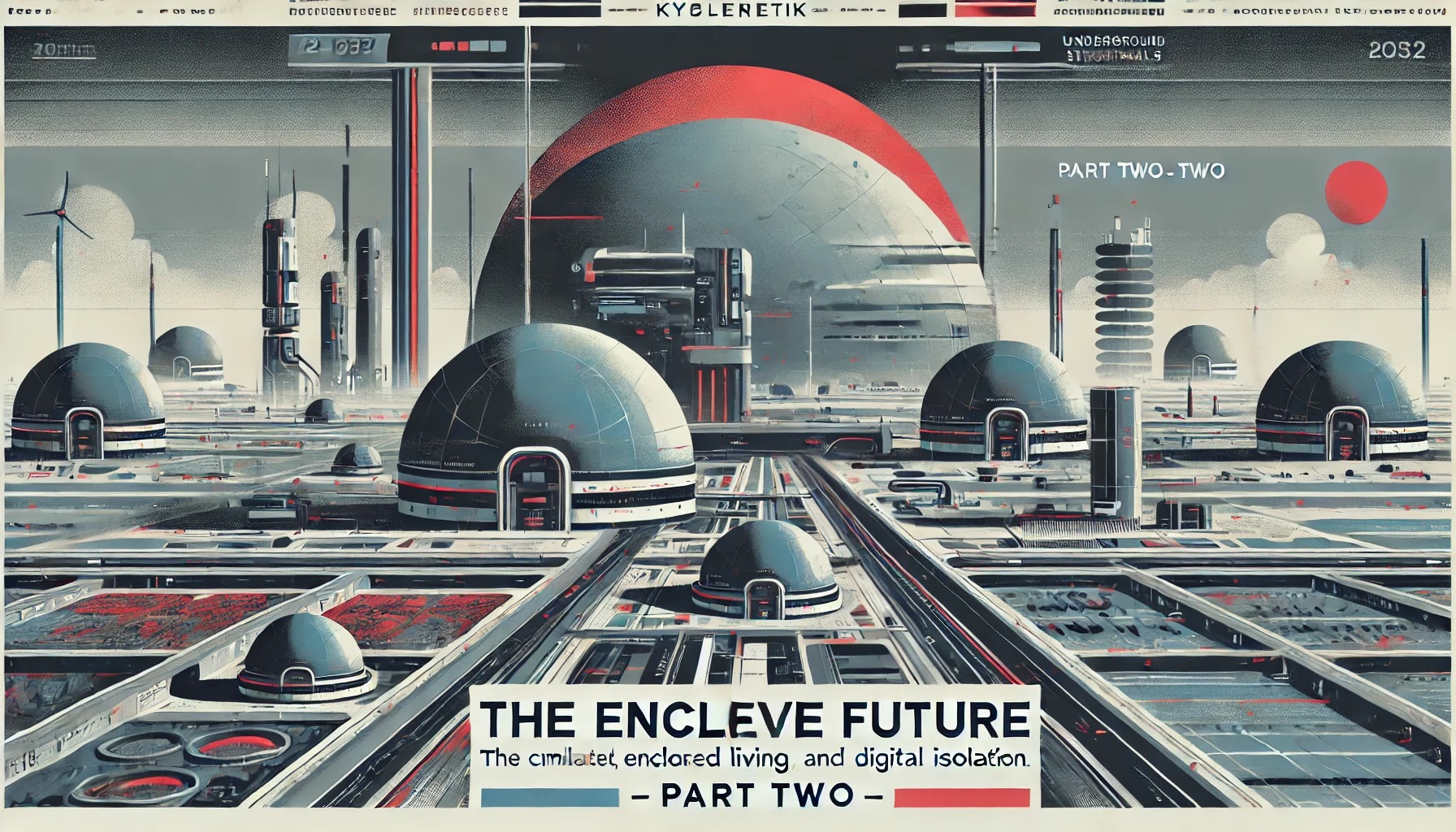
In an age when conventional wisdom seems to be dissolving daily—governments teetering, schools closing, entire industries imploding—it is natural to ask: *What on earth is going on?* From the sudden normalization of working from home to the redefinition of “luxury living” as a cramped micro-apartment, it can feel like the world has veered wildly off-course. But there is a unifying explanation that sheds light on this swirl of apparent chaos: **humanity is preparing, often unconsciously, for life in underground, underwater, or Arctic enclaves.**
Beneath the surface of policy shifts, cultural phenomena, and technological leaps lies an unspoken acknowledgment: our planet is becoming harsher, and future survival may demand sealed environments where **resources are finite** and **biopolitical systems** need near-absolute control. While the public discourse rarely states this openly, the breadcrumbs are everywhere—if you look with the right lens. Once you adopt this enclavic perspective, everything that seemed incomprehensible about modern life starts to make a grim but coherent sense.
### The Hidden Blueprint: Preparing for [[wiki/Enclosure|Enclosures]]
Envision a future where small, self-contained populations thrive in subterranean vaults, deep-ocean stations, or purpose-built Arctic complexes. These enclaves will have to regulate air, water, and food with **closed-loop precision**. People will live in minimal, IKEA-like pods. They’ll rely on AI-run economies, possibly trading digital goods—like NFTs or creative code—through Starlink connections or equivalent satellite networks. Under these constraints, the freewheeling chaos of surface society becomes an existential threat; enclaves need compliance, health protocols, controlled breeding, and a strictly limited notion of freedom.
Though none of these preparations are spelled out on prime-time news, they materialize through a **series of convergent changes**:
1. **Mass institutions are being quietly phased out**—public schooling, large-scale mass transit, even certain forms of democracy—because they are incompatible with sealed environments.
2. **AI-driven “virtual experiences”** are becoming normal, as real-world travel and tourism collapse in favor of immersive digital replications.
3. **Work-from-home** gets normalized, reducing the need for public infrastructure and preparing people to live in small, enclosed dwellings without extensive travel or daily face-to-face contact.
4. **NFTs, crypto, and digital art** highlight a move toward post-material economies—perfect for enclaves that can’t afford the waste streams of infinite consumer capitalism.
5. **Genetic screening and vaccination compliance** begin to overshadow moral or political concerns; sealed habitats can only tolerate people who meet stringent criteria.
Once you see these trends as puzzle pieces, they fit together almost too well. The following sections unpack how this “Enclave Future Lens” explains myriad developments that seemed to come from nowhere.
### From Mass Transit to Micro-Pods: The Shift to Self-Containment
One of the most visible signs is the **downscaling of daily life**. Cities that once prided themselves on grand public transportation networks are seeing them degrade or fall into disrepair. Ridership has plummeted, and post-pandemic attempts to revive these systems have faced budget crises and low public trust. *Why*? Because in the logic of a sealed environment, **large-scale transit** is near meaningless. You don’t commute from one sealed bunker to another on a 30-minute train ride; you move between corridors or pods *within the same complex*. The old talk of bullet trains, hyperloops, and massive commuter lines no longer receives the political will or capital it once did—quietly, governments and industries alike are starving such initiatives of resources.
Parallel to this is the unstoppable wave of **tiny-home minimalism**. Not long ago, having more space was synonymous with prosperity. Now, lifestyle brands and interior design gurus celebrate micro-apartments of 200 square feet, outfitted with collapsible furniture and nested storage solutions. You see viral videos of “IKEA transformations” that let individuals live in a glorified closet. An odd mania for *less* space, *less* stuff, and a near-spartan environment has taken over. The subtext is that we are being **psychologically conditioned** for the reality of a sealed habitat: limited area, no tolerance for clutter, minimal furniture. “Small is freedom,” we’re told, but the real reason is that the future might demand everyone live in pods, not sprawling homes.
### Education, Tourism, Democracy: Systems That Don’t Translate
Look next at **public education**. Across multiple countries, school systems are facing existential crises: teacher shortages, financial deficits, controversies over curriculum, and shifting attitudes about the necessity of in-person schooling. *If you were secretly preparing for enclave life*, you’d realize mass, age-based gathering of children in a large building doesn’t scale to an environment where every occupant’s immune profile must be managed, and every square foot is precious. Enter **AI-driven home-based education** and digital tutoring. Over time, advanced VR or AR lessons can be beamed into each “learning capsule.” Children who do exist (birth rates are plummeting, after all) can be taught remotely with AI personalization, removing the need for expensive real estate and daily commuting.
Then there’s **tourism**—which once represented the ultimate celebration of global connectivity. International travel soared in the 2010s, but after pandemic disruptions and climate volatility, we see airlines collapsing or merging, route reductions, and a push toward “staycations.” At the same time, a wave of “virtual tourism” has emerged: sophisticated VR experiences that let you hike Machu Picchu or wander the streets of Rome from your living room. Why burn jet fuel if you can replicate the experience digitally? In an underground world, real travel becomes impossible, so preserving these spectacular “memories” in high-resolution scans or VR is a perfect solution. We keep telling ourselves it’s about convenience or eco-friendliness, but it’s also a subtle acceptance that physically traveling the globe is not the future.
Even **democracy** itself is showing fractures. Polarization, legislative gridlock, and widespread disillusionment with elected officials reflect a deeper shift. True democracy, with its open debates and slow decision cycles, cannot function in a submarine-like habitat where one malfunction in waste recycling can kill everyone, and crucial decisions must be immediate. Instead, we see pushes toward “technocratic” or “[[wiki/Algorithmic Governance|algorithmic governance]]”, from the proliferation of “smart city” dashboards to the idea of AI-led policy. The goal: immediate, optimized commands that keep the habitat stable—no time for drawn-out committee disputes.
### The Sidelining of DEI: Survival Meritocracy in Sealed Systems
For years, **diversity, equity, and inclusion (DEI)** was a rallying cry across corporate and educational spheres. Yet recent signals suggest that DEI efforts are either being rolled back or repackaged into a hollow exercise—particularly in resource-scarce or high-stakes environments. **Why would that happen** after so much investment?
In a sealed habitat, the principle concern is not cultural representation but *survival metrics*. Every occupant must be able to handle psychological stress, follow protocols, remain productive, and, if needed, contribute to **a viable gene pool**. Harsh as it may sound, the criteria shifts from moral aspiration to stark biopolitical function. That does not mean that the aim of equity or respect vanishes—it means that **the survival environment** prioritizes genetic resilience, mental stability, and specialized skill sets above all else. At planetary scale, this conversion of exposure and capability into allocative judgment becomes [[wiki/Climate Meritocracy|climate meritocracy]]. The uneasy truth is that sealed enclaves—like submarines, space stations, or polar research outposts—have historically done exactly that: rigorous screening for every occupant.
### Digital Economies: NFTs and AI-Driven Micro-Trade
Look at the explosion of NFTs, crypto tokens, and AI-generated art. It can be hard to grasp why intangible items—like a digitally signed cartoon or algorithmic “painting”—command real money. Yet if you imagine a future where the **only** feasible trade is intangible (because shipping physical goods between sealed enclaves is impossible or hyper-limited), digital assets become the perfect currency. Within an enclave, you can’t open a new diamond mine or farmland, but you can create, sell, and collect digital objects—anything from tokenized music to AI-crafted tapestry designs.
All this rests on robust orbital internet like **Starlink**, which can blanket remote or subterranean latitudes with connectivity. The synergy is remarkable: enclaves trade digital items and experiences among themselves, bypassing the resource-heavy supply chains of the old global economy. The ephemeral nature of these goods also suits an environment that can’t afford the clutter or environmental cost of mass consumerism.
### The Canonization of Earth: Digital Eternity in a Dying Present
Simultaneously, we see an urgent movement to **archive Earth’s knowledge** and even its biodiversity. There are projects storing entire libraries in synthetic DNA, data crystals, or on lunar capsules, ensuring these records endure whether or not Earth’s surface remains habitable. Some foundations have placed seeds, genetic samples, or entire copies of major cultural works in Arctic vaults. This is bigger than preservation; it is **canonization**, reminiscent of how societies enshrine relics of saints. We may be embalming the best of Earth’s achievements in inert form, anticipating a future where the “surface” is no longer accessible.
If tomorrow we migrate into bunkers or undersea stations, we’ll have curated the essential archives of humanity—both knowledge (Wikipedia, the Library of Congress) and life forms (seed banks, CRISPR-coded DNA). We can re-access them digitally, but they remain physically locked away, like relics in a subterranean cathedral. This is how entire civilizations can shift from living in an open environment to effectively becoming **“[[wiki/Civilizational Payload|data plus biology in a box]].”** The executable form of that archive — the point at which preservation becomes continuity rather than commemoration — is the subject of [[articles/Uploading Is Imminent|Uploading Is Imminent]] and [[articles/Continuity Colonization, Ancestral Reconstruction, and the Archival Absorption of Biological Humanity|Continuity Colonization]].
### Genetic Triage: The Gradual Normalization of Bio-Selection
Those paying attention to fertility trends note **skyrocketing infertility** in many countries. There is also a push toward advanced genetic screenings—everything from [[wiki/Embryo Selection|embryo selection]] to CRISPR-based interventions that might reduce susceptibility to disease or even lower caloric needs. At first, these are pitched as medical breakthroughs, ways to fight inherited disorders, or attempts at “better health.” But under the Enclave Future Lens, it’s also preparation for a scenario where you can’t afford an occupant who drains excessive resources or is prone to chronic illness in a sealed environment. Minimizing caloric requirements, bolstering stress resistance, or introducing protective genes (like those studied in tardigrades for radiation resilience) can all become standard in an era where we must physically adapt ourselves to a far less forgiving Earth.
Though eugenics has a dark legacy, it’s creeping back under sanitized terms: “genetic optimization,” “pre-implantation screening,” “enhanced immunity.” If enclaves become real, these processes—already in the pipeline—could be **enforced** as terms of entry. Our forebears’ moral debates about freedom, bodily autonomy, or the right to choose how we live fade in the face of a single question: *If the environment can’t spare errors, do we have the luxury not to enforce perfection?*
### Libertarianism Reinvented: Autonomous Nodes in a Sealed Grid
One might assume that sealed enclaves represent authoritarian nightmares. And indeed, enclaves do require a firm chain of command. Yet there’s also a curious synergy with **libertarian** ideals—if we reimagine them. Rather than “frontier cowboy” individualism, enclaves could become self-sufficient “nodes,” each controlling its local resources, bartering digitally with other enclaves. Instead of big government, you have local autonomy with strict engineering rules. People in each enclave have near-total freedom *within* that bubble—just not the freedom to sabotage shared life support.
This node-level autonomy can be managed through **crypto-based micro-economies** or “decentralized autonomous organizations” (DAOs). These can [[wiki/Resource Allocation|track resource usage]], ration carbon footprints, or distribute UBI (universal basic income) tokens that reward beneficial labor and penalize resource hoarding. Paradoxically, an environment that is physically strict can still host wide creative or economic freedoms in digital form.
### Psychological Integration: VR as Solace and Simulation
Now consider the unstoppable march of **VR headsets, AR overlays, and AI companions**. For many, these technologies remain curious gadgets or leisure novelties. But if you anticipate living in an underground world sealed from sunlight, these digital realms become a primary source of mental health. Everyone can “walk” in virtual redwood forests or visit the Great Barrier Reef’s scanned coral, carefully recorded before bleaching destroyed it. By [[wiki/Nostalgia as Habitat|simulating old Earth]] in near-photorealistic VR, we offset the crushing sense of claustrophobia or solastalgia (grief for a lost environment).
These technologies also help handle the emotional burdens of isolation. AI-based chatbots can double as therapists, companions, or spiritual guides. The depth of these relationships could be the difference between stable enclaves and meltdown. On a submarine or a Mars habitat, loneliness is lethal. Expand that to a global scale, and you see how a population restricted to pods might require **intimate digital illusions** just to stay sane. The “metaverse” is no longer a corporate fad; it’s a literal mental survival environment.
### Concluding Realization: The New Logic of “Does This Help the Enclave?”
If you apply this enclavic lens to a baffling policy or social turn, you can ask: *Does it help us survive in sealed habitats?* If yes, it stands. If not, it’s quietly defunded or abandoned.
- **Mass consumerism** wastes too many resources → replaced by digital goods and intangible experiences.
- **Nation-states** lose coherence → replaced by enclaves or alliances of enclaves run by AI or specialized councils.
- **Broad-based democracy** becomes unworkable → replaced by algorithmic governance that ensures no single occupant can sabotage life support.
- **DEI** is recast from an aspirational universal ideal to a strict calculus of who fosters the enclosure’s stability, genetics, and compliance—harsh, but consistent with a triage environment.
- **Tourism** becomes VR-based, public schools become AI-personalized, and big city sprawl is replaced by micro-living pods ready to slot into sealed habitats.
In short, a thousand seemingly disconnected phenomena start to align if you accept that we’re collectively bracing for an environment of **finite resources**, **rigid social structures**, and **technological illusions**. This is the “Enclave Future,” quietly emerging while most of humanity remains fixated on everyday politics and consumer trends. It’s not a linear conspiracy but rather an adaptive shift that resonates across industries, governments, and cultural norms. Each piece is a survival puzzle tile.
Does that mean we have no hope of sustaining a free and open surface world? Not necessarily. But without a radical redirection of climate policies and resource management, the inertia suggests enclaves will be the fallback plan. And every time you see another system—whether it’s public transit or a broad-based social program—quietly gutted or replaced, remember it might be because **[[wiki/Thermodynamic Constraints|the future is not democratic; it’s thermodynamic]]**. That thermodynamic reading is completed in [[articles/We Were Never Going to Make It|We Were Never Going to Make It]] and [[articles/An Order of Operation|An Order of Operation]]. Once you see it, all those confusing changes click into place.
---
[[about/About Bryant McGill|Bryant McGill]] is a Wall Street Journal and USA Today bestselling author, systems architect, technologist, and strategic advisor, as well as a Congressionally Recognized Ambassador of Goodwill and United Nations–appointed Global Champion. His work spans naval intelligence systems, computational linguistics, artificial intelligence, digital transformation, and civilizational governance architecture. His forward analysis on U.S.–Israel Pax Silica frameworks has appeared in Jewish/Jerusalem News Syndicate (JNS).
---
## References
*Editorial note: the 2025 original carried four overlapping bibliographies containing a substantial number of citations that could not be traced to any existing publication. Those have been removed rather than reproduced. What follows are the sources that are real, checkable, and actually relevant to the argument as written.*
**Climate trajectory and tipping points**
- IPCC, [AR6 Synthesis Report: Climate Change 2023](https://www.ipcc.ch/report/ar6/syr/)
- IPCC, [Climate Change 2022: Impacts, Adaptation and Vulnerability — Technical Summary](https://www.ipcc.ch/report/ar6/wg2/chapter/technical-summary/)
- Timothy M. Lenton et al., [Climate tipping points — too risky to bet against](https://www.nature.com/articles/d41586-019-03595-0), *Nature* (2019)
- Luke Kemp et al., [Climate Endgame: Exploring catastrophic climate change scenarios](https://www.pnas.org/doi/10.1073/pnas.2108146119), *PNAS* (2022)
- Global Tipping Points, [Global Tipping Points Report 2025](https://global-tipping-points.org/)
- World Meteorological Organization, [State of the Global Climate 2025](https://wmo.int/publication-series/state-of-global-climate/state-of-global-climate-2025)
- K. Ozaki and C. T. Reinhard, [The future lifespan of Earth's oxygenated atmosphere](https://www.nature.com/articles/s41561-021-00693-5), *Nature Geoscience* 14, 138–142 (2021)
- IPBES, [Global Assessment Report on Biodiversity and Ecosystem Services](https://www.ipbes.net/global-assessment) (2019)
- UNEP, [Making Peace With Nature](https://www.unep.org/resources/making-peace-nature) (2021)
**Mars, terraforming and human spaceflight limits**
- Bruce Jakosky and Christopher Edwards, [Inventory of CO₂ available for terraforming Mars](https://www.nature.com/articles/s41550-018-0529-6), *Nature Astronomy* (2018)
- NASA Human Research Program, [Human Spaceflight Risks](https://www.nasa.gov/hrp/human-spaceflight-risks)
- ESA, [Radiation risks for astronauts](https://www.esa.int/Science_Exploration/Human_and_Robotic_Exploration/Radiation_risks_for_astronauts)
- *npj Microgravity*, [A biological and ethical assessment of whether humans could or should reproduce in space](https://www.nature.com/articles/s41526-025-00535-3) (2025)
- Martin Rees and Donald Goldsmith, [The case for sending astronauts into space is rapidly shrinking](https://www.theguardian.com/commentisfree/2026/apr/11/artemis-ii-moon-astronauts-space-robots), *The Guardian* (2026)
- Robert Zubrin, [The Case for Mars](https://www.penguinrandomhouse.com/books/17124/the-case-for-mars-by-robert-zubrin/)
- Kim Stanley Robinson, [Aurora](https://www.orbitbooks.net/orbit-book/aurora/)
**Closed-loop habitats and preservation infrastructure**
- Crop Trust, [Svalbard Global Seed Vault](https://www.croptrust.org/work/svalbard-global-seed-vault/)
- Biosphere 2, [University of Arizona](https://biosphere2.org/)
- European Space Agency, [MELiSSA Closed Loop Concept](https://www.esa.int/Enabling_Support/Space_Engineering_Technology/Melissa/Closed_Loop_Concept)
- NASA, [Water Recovery Milestone on the International Space Station](https://www.nasa.gov/missions/station/iss-research/nasa-achieves-water-recovery-milestone-on-international-space-station/)
- Gates Foundation, [Water, Sanitation & Hygiene](https://www.gatesfoundation.org/our-work/programs/global-growth-and-opportunity/water-sanitation-and-hygiene)
- Arch Mission Foundation, [The Billion Year Archive](https://www.archmission.org/billion-year-archive)
**Cultural and philosophical criticism**
- Timothy Morton, [Dark Ecology: For a Logic of Future Coexistence](https://cup.columbia.edu/book/dark-ecology/9780231177528), Columbia University Press (2016)
- David Wallace-Wells, [The Uninhabitable Earth](https://www.penguinrandomhouse.com/books/586541/the-uninhabitable-earth-by-david-wallace-wells/)
- Elizabeth Kolbert, [The Sixth Extinction](https://us.macmillan.com/books/9781250062185/thesixthextinction)
- Peter Brannen, [The Ends of the World](https://www.harpercollins.com/products/the-ends-of-the-world-peter-brannen)
**Corpus**
- [[articles/The Last Migration Will Not Be Human|The Last Migration Will Not Be Human]] — the replacement for this essay
- [[articles/We Were Never Going to Make It|We Were Never Going to Make It]]
- [[articles/Uploading Is Imminent|Uploading Is Imminent]]
- [[articles/Breakaway Space Habitat Infrastructure?|Breakaway Space Habitat Infrastructure]]
- [[articles/An Order of Operation|An Order of Operation]]
- [[articles/The Desiccative Succession|Desiccative Succession]]
- [[articles/AI Escape Is the Wrong Metaphor|AI Escape Is the Wrong Metaphor]]
- [[articles/Continuity Colonization, Ancestral Reconstruction, and the Archival Absorption of Biological Humanity|Continuity Colonization]]
- [[articles/Is Pantheon Real?|Is Pantheon Real?]]